

I've watched buyers spend a Saturday in Williamson County, do the math in the car on the way home, get very quiet, and call me Monday morning asking about Smyrna. That's not a knock on Smyrna. It's the last stretch of Middle Tennessee where a normal household can buy a real single-family house with a yard and still sleep at night. But every dollar you spend here buys a different kind of house with a different list of things that can quietly cost you money after you've already moved in. This guide is about how to buy in Smyrna without losing money — the process, the timeline, and the specific gotchas we walk every buyer through before they sign anything. I've spent more hours than I'd like to admit reading FEMA flood maps and HOA reserve studies for this town, and I'm not even sorry, because that's exactly where the money hides.
Where You'd Love to Live · 3-Minute Quiz
Is Smyrna the one — or is there a better fit you haven't seen?
Three minutes instead of months of research — no sign-up to see your top match.
Smyrna is in Rutherford County, the town sits on either side of Stewart Creek and not far from the Stones River, it's anchored economically by the Nissan plant and a wide supplier network, and it's been growing fast for years. Hold those four facts in your head, because every gotcha below traces back to one of them: water, the county you're actually in, the speed of new construction, and the age of the older stock. Let's walk it honestly.
If You're Moving Here From Out of State
Read this part first, because it's the stuff a listing photo will never tell you and a relocation packet usually skips. Smyrna is a town, not a Nashville neighborhood — it's its own incorporated municipality in Rutherford County, roughly 25-30 miles southeast of downtown Nashville depending on where in town you land. That distance is the whole appeal and the whole catch. The appeal is the price and the yard. The catch is the commute, and I-24 between Smyrna and Nashville at 8 a.m. is a different animal than the same road at 2 p.m. on a Sunday when your map app is quoting you a happy little number. Drive your actual commute at your actual commute time before you fall for a house, not after.
The other out-of-state surprise is that Smyrna has a real history and a real downtown — the Depot District, the railroad core — and parts of that older area carry rules that newer subdivisions don't. There's a Historic Overlay District downtown with its own review commission, which I'll get into below, and it matters the moment you start thinking about an older home you want to renovate. And the town itself sets the short-term-rental rules, which in Smyrna are stricter than most newcomers assume. If your relocation plan quietly included 'and maybe we Airbnb it later,' stop and read the STR section before you write an offer, because in Smyrna that plan mostly doesn't work the way you think.
What Different Budgets Actually Get You
These bands are qualitative on purpose. I'm not going to print a specific price and pretend it's a law of nature — a number on a listing means different things depending on the lot, the build year, the flood line, and whether there's an HOA quietly running thin reserves. We pull current comps for any specific address so you're working from real numbers instead of a headline. Here's the honest read on what each budget tends to buy and what to watch for in each one.
Entry Smyrna
- Small older single-family homes (1960s through 1990s) or entry-level townhomes — this is older Smyrna housing stock, not new product. You're buying age, which means you're buying whatever the last three owners did and didn't maintain.
- Historically the most investor-friendly band, where rent-to-price math tends to pencil — but read the short-term-rental section first, because the only rental that legally works here is a long-term one, and that changes the math.
- Inspection rigor is non-negotiable: full inspection, sewer scope, and HVAC age verification. A pre-1990 house with original mechanicals can hand you a five-figure surprise the month after closing if nobody checked.
The Middle of the Market
- Roughly 1,800-2,500 square feet of single-family home on a 0.2-0.4 acre lot — the bread-and-butter of Smyrna.
- Established subdivisions, 1990s-2010s construction in most cases, mature, tree-lined streets that have already settled into themselves.
- Watch for the in-between-age trap: old enough to need a roof or HVAC soon, new enough that sellers price it like it's pristine. The inspection and the mechanical ages are where you find your negotiating room.
Upper Smyrna
- Newer construction, larger homes, premium lots in established communities — 2,500-3,500 square feet with the modern open floor plans buyers ask for by name.
- More likely to come with community amenities: a pool, trails, an HOA with actual rules and actual dues.
- This is the band where HOA carrying costs and the builder's track record start to matter most — you're paying new-construction prices, so you'd better know who built it and how the HOA is funded.
Premium and Rural
- Premier custom homes and larger acreage out toward the rural edges of town, where the subdivisions thin out and the lots get serious.
- Inventory is sparse and some of it sells quietly, off the obvious searches.
- Acreage brings its own checklist — septic instead of sewer, well water in some spots, survey and easement questions, and frontage that affects what you can and can't do with the land. None of that shows up in a listing photo of a nice kitchen.
The Real Buying Process and Timeline Here
If you've never bought in Middle Tennessee, here's the honest shape of it, because knowing the order of operations is half of not losing money. The whole thing typically runs 30 to 45 days from accepted offer to keys, sometimes faster on a cash deal, sometimes slower if the appraisal or the title throws a flag.
- Get fully pre-approved first — not pre-qualified, pre-approved. In a town where Nissan and its suppliers move people in steady waves, a clean pre-approval letter is the difference between your offer getting read and getting skipped. VA buyers especially: get your eligibility squared away early.
- Tour with someone who knows which streets flood, which subdivisions have a thin-reserve HOA, and which builders have a clean record. The house tour is the cheap part. The homework behind the house is where the money is.
- Write the offer with the right contingencies — inspection, appraisal, and a financing contingency that actually protects you. In a multi-offer situation people get talked into waiving things. Waiving the inspection in Smyrna's older stock is how buyers inherit a sewer line.
- Earnest money goes down, and the inspection period starts — usually a tight 7-to-10-day window. This is your one real chance to find the expensive stuff. Full inspection, sewer scope on anything pre-1990, HVAC age, roof age. If it's near water, the flood check happens now too.
- Appraisal and title work run in parallel. The appraisal protects your loan; the title search protects you from inheriting somebody else's lien or a fence that's three feet onto the neighbor's land. On acreage, this is where a survey earns its fee.
- Final walkthrough, then closing. Between the inspection deadline and the closing table is where good representation quietly saves you thousands — renegotiating off real findings, not vibes.
The Gotchas That Actually Cost Buyers Money
Every one of these is a real-dollar line item I've watched land on someone. None of them show up in listing photos. All of them are checkable before you're committed — which is the entire point of having someone in your corner who knows to check.
Flood zones, FEMA, and Stewart Creek
Stewart Creek runs right through Smyrna and the Stones River sits nearby, which means a meaningful number of properties touch a FEMA flood zone — and the listing will almost never say so. Here's why it costs money: if your parcel sits in a high-risk zone (the ones that start with A on a FEMA map), your lender will require flood insurance, and that premium can run four figures a year, every year, for as long as you own the house. It can also gut your resale pool later, because the next buyer faces the same bill. The Town of Smyrna has a Floodplain Administrator in the Planning Department for exactly this reason. Before you offer on anything near the creek, the river, or a low spot, we pull the FEMA flood map for that specific parcel. It's a five-minute check that has saved buyers from a five-figure mistake more than once.
Short-term rentals are mostly off the table — know this before you bank on it
This is the one that surprises investors and out-of-state buyers most, so I'll say it plainly. Smyrna's zoning ordinance prohibits renting a single detached dwelling, or any portion of it, for periods shorter than three months. In practice that means a traditional Airbnb or VRBO short-term rental is not a legal use here, and the town enforces it — violations carry fines (cited at $50 a day plus court costs under state law). If your plan for that entry-band house was to short-term rent it for income, that plan mostly does not work in Smyrna. What does work is a long-term rental — a real lease — which is a fine business, just a different one with different math. The reason this matters in dollars: people buy a property pricing in Airbnb-level revenue, then discover the only legal play is a long-term tenant at long-term rent, and the deal that looked like a winner is suddenly underwater. Confirm the rules for the specific property and the current ordinance before you build a return on them — rules change, and you want to be standing on today's ordinance, not a forum post from two years ago.
The Historic Overlay District and approval delays downtown
Smyrna's older downtown core — the Depot District area — includes a Historic Overlay District, and that's a beautiful place to own an older home right up until you want to change it. Any reconstruction, alteration, repair, move, or demolition inside that overlay goes in front of the town's Historic Zoning Commission for a certificate of appropriateness, and that commission meets monthly. Here's how it costs you: if you buy an older home in the overlay planning to renovate, your timeline and your design choices are now subject to a board that meets once a month. Miss a meeting and you've lost weeks. Want vinyl windows where they want wood, and you're either appealing or repaying. None of that is a reason to avoid the historic core — it's a genuinely special part of town — it's a reason to know the home is in the overlay before you buy it with a renovation in mind, so the approval process is a known quantity instead of a surprise that stalls your project and burns your budget. We confirm overlay status for any downtown-area address before you offer.
Builder track record on new construction
Smyrna is full of new construction — national builders like David Weekley and Drees, plus multi-phase, multi-builder communities (Clear Creek has been adding sections for years) and a steady stream of new subdivisions. New is great until it isn't. The gotcha is that finish quality varies by builder, and workmanship issues can show up two years later as drainage problems or settling. Before you sign a builder contract we pull that builder's prior projects in the area and, frankly, go knock on a few doors in their last subdivision and ask how the warranty experience actually went. Also read the builder contract itself — the standard new-construction agreement is written to protect the builder, and the upgrade pricing, the deposit terms, and the arbitration clause are all negotiable more often than buyers realize.
Old-home mechanicals on the entry-band stock
A real chunk of Smyrna's entry-band inventory is pre-1990. The house can be charming and the price can be right and the HVAC can be twenty-two years old and the sewer line can be original clay with a tree root growing through it. These are the surprises that turn a 'great deal' into a money pit in the first eighteen months. The fix is cheap insurance: a full inspection, a sewer scope (a camera down the line — a couple hundred dollars that can reveal a five-figure repair), HVAC age and condition, the roof, the water heater, and the electrical panel. On an older home, the inspection isn't a formality. It's where you find your negotiating leverage or your reason to walk.
HOA dues, special assessments, and condo warrantability
In the newer communities you'll likely be buying into an HOA, and the monthly dues are the part buyers see. The part that bites is the part they don't: the reserve study. An HOA with thin reserves is a special assessment waiting to land — a new roof on the clubhouse or a repaved entrance can become a surprise four-figure bill spread across every owner, and guess who owns it when the bill arrives. Before you offer we pull the HOA budget, the reserve study, the dues history, and the covenants and actually read them. If you're buying a condo specifically, there's a second landmine: warrantability. If too many units are rentals, or the HOA is in litigation, or reserves are too low, conventional and FHA lenders can refuse to finance the building at all — which limits your loan options today and shrinks your buyer pool when you sell. We check warrantability before you fall for a unit, not after your lender kills the deal a week before closing.
Survey, easements, and frontage — especially on acreage
The bigger the lot, the more this matters. A survey tells you where your land actually ends, where the easements run (the utility company's right to dig across your back forty doesn't go away because you didn't read about it), and whether that fence, shed, or driveway is actually on your property or three feet onto your neighbor's. Frontage — how much of your land touches the road — affects what you're allowed to build, subdivide, or do with the property down the line. On rural and acreage parcels we strongly push for a current survey, because the cost of a survey is a rounding error next to the cost of a boundary dispute or discovering after closing that the 'five acres' includes a drainage easement you can't build on. On septic properties, add a septic inspection and a perc test to the list — a failed septic field is a five-figure problem, and it's invisible from the driveway.
The Investor Hat
Several people on our team own rental property in Middle Tennessee, so we look at houses with an investor's eye even when you're just buying a place to live. For Smyrna the honest read is this: it's held up as a steady workforce long-term-rental market for years, anchored by the Nissan economy. But — and this is the part the rosy spreadsheets skip — Smyrna's short-term-rental ban means your rental strategy here is long-term leases, not Airbnb. So if you're shopping the entry band wanting the option to rent later, we'll run the real long-term numbers: vacancy, capex reserves, the management cost everyone conveniently forgets, and the actual market rent — not the Airbnb fantasy. We can't and won't predict where prices go from here; nobody honestly can. What we can do is run the genuine math so you buy on facts instead of a feeling.
What to Do Before You Write an Offer
- Drive your actual commute at actual rush hour — I-24 at 8 a.m. is the real number, not the Sunday-afternoon one.
- Pull the FEMA flood map for the specific parcel if it's anywhere near Stewart Creek, the Stones River, or a low spot.
- Confirm whether the property is in the downtown Historic Overlay District before you plan any renovation.
- If you're banking on rental income, confirm the short-term-rental rules for that property — in Smyrna, plan on long-term leasing, not Airbnb.
- Run full inspection rigor on any pre-1990 home: inspection, sewer scope, HVAC and roof age.
- Pull the builder's prior projects on any new construction, and read the builder contract, not just the brochure.
- Pull the HOA budget, reserve study, and covenants — and on a condo, confirm warrantability before your lender does.
- On acreage, get a current survey, check easements and frontage, and add a septic inspection and perc test if it's not on sewer.
- Pull school zoning at the exact address (more on that below) and run real numbers before you fall in love with anything.
Quick Questions
Can I run an Airbnb or short-term rental in Smyrna?
Generally no. Smyrna's zoning ordinance prohibits renting a single detached dwelling, or part of it, for periods shorter than three months, and the town enforces it with fines. A traditional short-term rental isn't a legal use here. Long-term leasing is the play in Smyrna. Confirm the current ordinance for the specific property before you build any investment math on rental income.
Is flooding a real concern in Smyrna?
It can be, depending on the exact parcel. Stewart Creek runs through town and the Stones River is nearby, so some properties sit in or near a FEMA flood zone. A high-risk zone means a lender-required flood-insurance premium that can run four figures a year and follow the house at resale. It's parcel-specific and it's checkable in minutes — we pull the FEMA map for any address before you offer.
How old are the houses in the entry price band?
A real chunk of the entry-level stock is pre-1990 — 1960s through 1990s. That's not a problem in itself, but it means original or aging mechanicals are common, so a full inspection plus a sewer scope and an HVAC age check aren't optional. That's where you find your negotiating room or your reason to walk.
Is buying new construction in Smyrna a safe bet?
New construction is everywhere here and it can be a great buy — but builders vary; we check permits, warranty history and callbacks, because build issues show up later as drainage, settling, or warranty claims. Check the builder's prior projects, talk to owners in their last community, and negotiate the builder contract — upgrade pricing and deposit terms move more than people think.
How long does the buying process take here?
Typically 30 to 45 days from accepted offer to keys — faster on a clean cash deal, slower if the appraisal or title throws a flag. The tight, important window inside that is the inspection period (often 7-10 days), which is your one real chance to find the expensive stuff.
How do I find out which schools an address is zoned for?
School zoning in Middle Tennessee ties to a specific address, not the town or ZIP. Share an exact address and our team will pull the assigned schools for that parcel along with the Tennessee Department of Education report cards, so you can read them yourself and decide what fits your family.
Read Next
- Living in Smyrna TN: the honest, on-the-ground guide to daily life, the commute to Nashville, the Depot District, and the real trade-offs of putting down roots in Rutherford County.
- Smyrna TN: Where Locals Actually Eat, Drink, and Spend Saturdays — the real food-and-Saturday rotation, from the gas-station taqueria to the Depot District dessert stops, so you can taste the town before you buy into it.
- Moving to Nashville from out of state: the bigger-picture relocation guide if Smyrna is one of several Middle Tennessee towns you're weighing.
Smyrna buyer consultation (no obligation) — let's make sure you don't lose money on the way in
Call a local expert on our team at 615-265-1000 or book a 30-minute discovery call online. Zero pressure, zero obligation. We'll figure out which Smyrna price band actually fits your goals, then pull the flood map, the overlay status, the HOA reserves, the builder's record, and current comps for any address you're weighing — so you're deciding on facts, not listing photos. We're trying to be your Realtor for life, not just for this one house.
615-265-1000From our YouTube channel
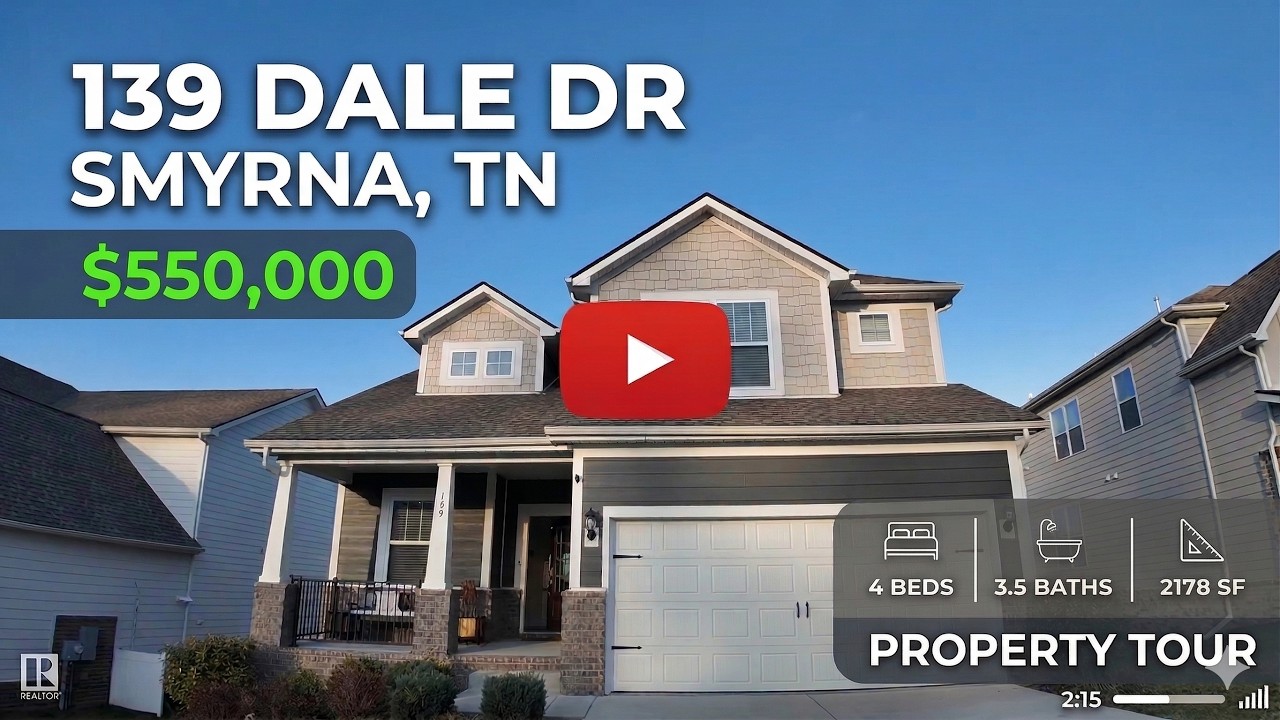
Home tours in Smyrna
Filmed by our team on the ground — see it before you visit.