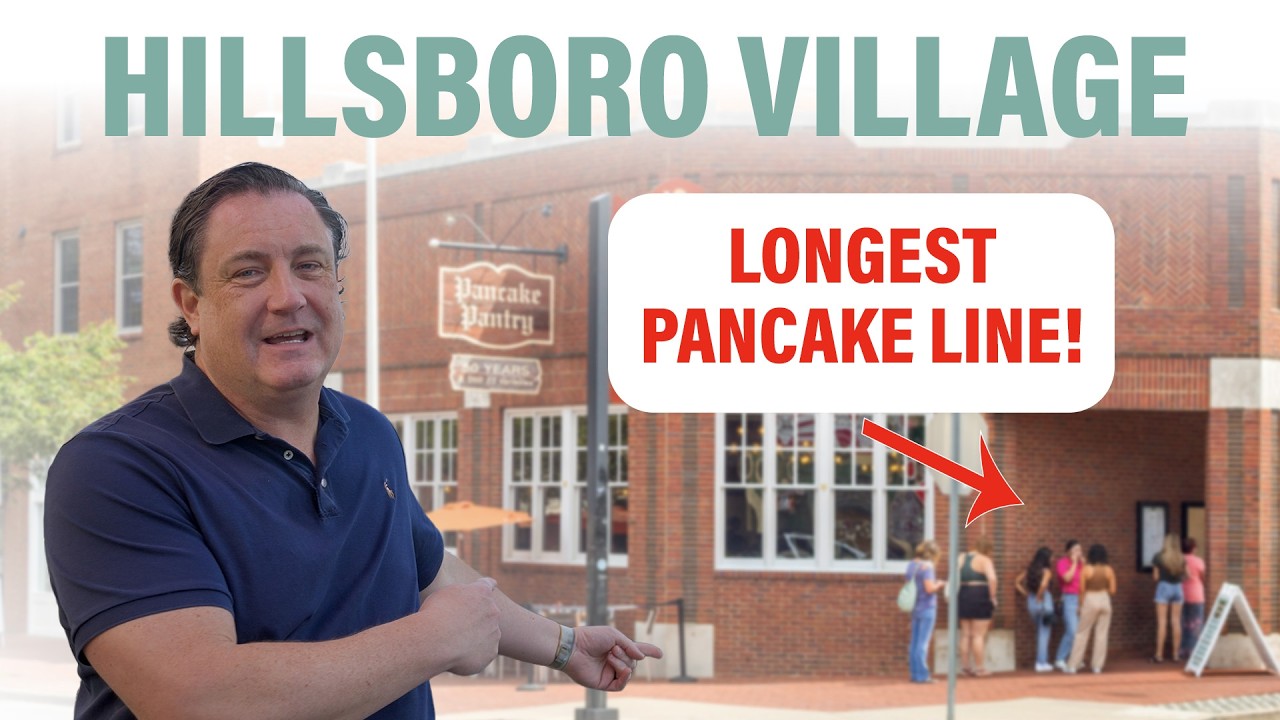


Hillsboro Village is small enough that you can walk the whole thing before a coffee from Fido goes cold, and I've done exactly that more than once while a client circled the block trying to decide. That smallness is the entire story. The pool of active listings is tight, well-priced homes pull multiple offers, and the difference between a smart buy and an overpay almost never shows up in the photos — it hides in a flood panel, a conservation-overlay review, a builder's track record, or a clay sewer line that's been quietly losing a fight with a tree root since the Eisenhower administration. This is the honest guide to buying here without leaving money on the table. Not the brochure version.
Where You'd Love to Live · 3-Minute Quiz
Is Hillsboro Village the one — or is there a better fit you haven't seen?
Three minutes instead of months of research — no sign-up to see your top match.
A quick note on what 'Hillsboro Village' even means, because it matters for everything below. Locals use the name two ways. The tight version is the commercial strip on 21st Avenue South — Fido, Pancake Pantry, the Belcourt. The version you actually buy a house in is the residential fabric wrapped around it, most of which sits inside the Belmont-Hillsboro neighborhood, listed on the National Register of Historic Places since 1980 and covered by a conservation zoning overlay. Roughly eleven hundred properties live under that overlay. Whether your address is inside it or just outside it changes what you can build, how long approvals take, and what you should pay. We pull that for every property before you write.
If You're Moving Here From Out of State
Orientation first, because the area is smaller and more sliced-up than a relocation map suggests. The 21st Avenue South strip is the spine. The homes fan out east and west into streets of streetcar-era bungalows, American Foursquares, Tudor Revivals and the occasional modern infill build squeezed onto a narrow lot. Most of the housing stock went up between roughly 1910 and 1935, which is the single most important fact for an out-of-state buyer to absorb: you are almost always buying an old house, or a new house standing where an old one used to be, and both carry homework the listing won't do for you.
The other thing to internalize early: this is not a 'pick a floor plan and a price' market. It's a property-by-property market where lot width, parking, the overlay line, the flood panel, and the quality of a past renovation swing the real value more than headline square footage does. Two bungalows on the same street, same beds and baths, can be a genuinely good buy and a genuinely bad one. The job of a good buyer's agent here isn't to find you a house — the listings are public, you'll find them yourself. It's to keep you from overpaying for the one with the problems you can't see at the open house.
What Different Budgets Actually Get You
These are qualitative ranges, not predictions, and inventory in every band is thin — sometimes there's nothing for sale at your number for weeks. We can't tell you where prices go from here; nobody honestly can. What we can tell you is what a given budget has historically put within reach in this specific pocket, so you walk in with a realistic picture instead of a Zillow-induced one.
Smaller Cottages and Condos
Entry-level Hillsboro Village usually means a smaller cottage or bungalow under about 1,400 square feet, often one that needs real work, or a condo or townhome in a select development. Inventory at this band is the thinnest in the neighborhood, so the trap here is emotional: when the only thing in your range finally appears, the temptation is to overpay out of relief. Don't. The condo path also opens a separate can of diligence — dues, reserves, special-assessment history, and lender warrantability — that we walk through below.
The Heart of the Market
This is where the most transactions happen, and it's a mix:
- Updated 1920s–1940s craftsman bungalows, roughly 1,400–1,800 sq ft, two to three bedrooms.
- Smaller renovated colonial cottages with original character intact.
- Newer townhomes in select small developments.
Multiple offers happen in this band, and that is when buyers are most at risk of overpaying. The deals that go sideways here almost always skipped one of the gotchas below — usually the inspection homework on an old house, or a renovation that looks finished and isn't.
Fully Renovated and Premium Singles
Significantly renovated bungalows with expanded floor plans, newer modern infill, or restored historic homes — roughly 2,000–2,800 sq ft. This is the most-loved daily-life range, and it's also where 'renovation quality' becomes the whole ballgame. A gut renovation done right and a lipstick-on-an-old-house flip can list ten feet apart at the same price. One of them costs you $60K in years two and three. Telling them apart is the work.
Premier Hillsboro Village
The top of the typical market: newer custom homes, larger restored historic homes, or premier modern infill. Buyers in this band are established Nashville move-up buyers and relocators willing to pay up for the specific walkable character. At this price the gotcha shifts toward new construction and builder track record — because a lot of the inventory here is recently built or rebuilt, and not every builder who put up a pretty facade did the parts you can't see as well.
Trophy Properties
Less common, and inventory is sparse — corner lots, larger custom builds, or signature restorations. Teardown-and-rebuild has reached this neighborhood: midcentury houses have been bought for the land and replaced by new builds. When the dirt is worth more than the house, every assumption about comparable sales changes, and you need an agent who can tell you whether you're paying for a home or paying for a lot with a house in the way.
The Real Buying Process and Timeline Here
Buying in a low-inventory, high-competition pocket runs differently than buying in a subdivision where six similar homes are for sale. Here's the honest sequence so nothing surprises you.
- Get fully underwritten first, not just pre-qualified. In a multiple-offer market, a pre-qual letter and an underwritten approval are not the same weapon. Sellers and listing agents can tell the difference, and the stronger letter wins ties that cost real money.
- Set a walk-away number in writing before you tour. The hardest negotiation you'll have here is the one with yourself at 9 p.m. when a competing offer comes in. Deciding your ceiling in advance — in writing — is the single cheapest way to avoid overpaying on these blocks.
- Move fast, but inspect anyway. Well-priced homes can go to contract in days, which tempts buyers to waive inspection to win. On a pre-1950 house, waiving inspection is how a winning offer becomes a losing purchase. Compete on terms and certainty of close — not by blinding yourself to the sewer line.
- Build a realistic diligence window. An old-home inspection here should include a sewer scope and an honest look at mechanicals, foundation, and any past renovation permits. If the home is in the conservation overlay and you plan to add on, factor review time into your post-close plans — it's a real calendar item, covered below.
- Underwrite the property, not the listing. The list price reflects what the seller hopes for. Comparable sales, condition, lot, parking, and the gotchas reflect what it's worth. Our job is to keep those two numbers from drifting apart in your offer.
The Gotchas That Cost Buyers Real Money
Each of these is concrete, each is checkable before you write, and each one — left unchecked — has cost a Hillsboro Village buyer somewhere. This is the part of the guide that pays for itself.
1. Flood and FEMA — check the panel, not the vibe
Parts of this side of Nashville sit near creeks and low drainage, and a flood-zone designation is address-specific — the house next door can be in a different zone than the one you want. Why it costs money: a property in a FEMA Special Flood Hazard Area can require flood insurance as a condition of your mortgage, and that premium is a permanent line item that follows the house, not a one-time fee. It also dents resale, because the next buyer inherits the same requirement. Before you fall for anything, we pull the FEMA flood panel through the FEMA Map Service Center and Metro Water Services' flood tool for the exact parcel, and you find out the real number before it's a closing-week shock instead of after.
2. Short-term rental rules — assume you can't, then verify
If any part of your math counts on Airbnb income, read this twice. Most of the residential fabric here is zoned RS or RM, and under current Metro rules, new non-owner-occupied short-term rental permits are not issued in those residential zones. Owner-occupied permits exist, but they require that a natural person actually, permanently live at the property — no LLCs, trusts, or corporations — and they're generally one per lot and not transferable when the home sells. Why it costs money: buyers have paid a premium for a home assuming STR income that the zoning will never legally allow, and the income they underwrote simply doesn't exist. STR rules are property-specific and they change, so we verify the exact zoning and current permit status for the specific address — never the block, never the unit next door — before any rental assumption goes into your offer.
3. Conservation overlay — approval is a calendar item, not a formality
Much of the residential area falls inside the Belmont-Hillsboro Conservation Zoning Overlay, which sits on top of the base zoning across roughly eleven hundred properties. Here's the part buyers get wrong in both directions: the overlay reviews new construction, additions, demolition, and relocation — not your interior finishes, paint, or kitchen. So you can renovate inside freely, but if your plan is to pop the top, add a primary suite, or build new, that work goes before the Metro Historic Zoning Commission for a certificate before permits issue. Why it costs money: that review is a real timeline and a real design constraint. Buyers who closed assuming they'd add 800 square feet next spring have been caught flat by the approval process and the guidelines on height, mass, and street rhythm. If your purchase depends on an addition, we confirm whether the parcel is in the overlay and what the guidelines allow before you write — so the renovation you're paying for is one you can actually build.
4. New construction and builder track record — pretty isn't proof
Infill and teardown-rebuild are real and increasing here, which means a meaningful share of the higher-band inventory is newly built. A new build removes the old-house mechanical risk, but it adds a different one: not every builder who delivered a magazine-worthy facade did the framing, drainage, waterproofing, and HVAC sizing as carefully. Why it costs money: a builder cutting corners on the parts behind the drywall hands the bill to whoever owns the house when it shows up — water in the crawlspace, an undersized system, a flashing detail that fails in year three. Before you buy new construction here, we research the builder's track record, pull permits and any prior complaints, and have your inspector evaluate the build — not just admire the finishes. A walk-through inspection on new construction is not optional; it's where you find out which builder you actually bought from.
5. Old-home mechanicals — sewer-scope everything pre-1980
Pre-1950 bungalows come with the standard set of old-house realities — knob-and-tube wiring surprises, clay sewer lines, a foundation that has opinions about the weather, original galvanized supply lines that have quietly narrowed for eighty years. Why it costs money: a clay sewer line that's been losing an argument with a tree root for forty years is a four-or-five-figure repair, and finding it the week before closing instead of during inspection changes who pays. Sewer-scope anything pre-1980. Have your inspector evaluate the actual systems — not the finishes — and budget for the ongoing investment an old house genuinely asks of you. None of this is a reason not to buy; it's a reason to price it in.
6. HOA and condo dues — the low fee can be the red flag
If you're buying a condo or townhome here, the building's finances matter as much as the unit. Why it costs money: a beautiful unit in an underfunded association is a special-assessment surprise waiting to land in your lap, and a low monthly due can mean a thin reserve, which means the next roof, elevator, or facade repair gets billed to owners as a lump sum. There's a second, quieter trap for condo buyers — lender warrantability. If too many units are renter-occupied, the reserves are too thin, or there's pending litigation, the project can be deemed non-warrantable, and conventional financing dries up. That shrinks your future buyer pool and can torch your own loan mid-deal. We pull the HOA budget, the reserve study, the special-assessment history, and the warrantability picture on any unit you're serious about, so the building isn't the thing that costs you money in year three.
7. Survey, easement, and frontage — narrow lots, real lines
Hillsboro Village lots are narrow and the yards are small, and on streetcar-era parcels the legal lines and the fences rarely went to the same school. Why it costs money: a fence, driveway, or shed that has crept across a property line, a shared driveway with no recorded agreement, or a utility easement running through the spot you wanted the addition — any of these can blow up a renovation plan, a future sale, or a neighbor relationship, and untangling it later costs far more than ordering a survey now. Walk the actual property line before you fall in love, and on anything where the lot drives the value — which here is most things — get a current survey and read the title commitment for easements before you remove contingencies. Off-street parking and a clean lot line are worth real money on these blocks precisely because so few homes have both.
The Investor-Hat Lens
Several agents on our team have active investor backgrounds, and the same property-specific factors that decide investment math decide a primary-residence purchase too. Lot quality, parking, renovation quality, flood status, overlay constraints, and condition relative to comparable sales all compound. None of it changes whether you love the kitchen. All of it changes what you should pay for the house the kitchen is in. That's the whole value of having someone in your corner who underwrites the property and not just the listing.
Quick Questions
Short, honest answers to what buyers actually ask before writing an offer in Hillsboro Village.
Is Hillsboro Village in a flood zone?
It's address-specific — some parcels sit near creeks and low drainage and some don't, and two neighbors can be in different zones. A Special Flood Hazard Area designation can trigger a permanent flood-insurance requirement on your mortgage, so it affects your real monthly cost and resale. Share an address and our team will pull the FEMA flood panel and the Metro Water Services flood data for that exact parcel before you write.
Can I run an Airbnb or short-term rental here?
Assume no until verified. Most homes here are in RS or RM residential zoning, where Metro currently issues no new non-owner-occupied STR permits. Owner-occupied permits require a real person living at the property permanently, are generally one per lot, and don't transfer when you sell. Rules are property-specific and change, so we confirm the exact zoning and current permit status for the specific address before any rental income goes into your math.
Can I add on or pop the top?
Maybe — but if the parcel is inside the Belmont-Hillsboro Conservation Zoning Overlay, additions, new construction, and demolition go before the Metro Historic Zoning Commission for review before permits issue, with guidelines on height, mass, and street rhythm. Interior renovations aren't reviewed. If your purchase depends on an addition, we confirm overlay status and what the guidelines allow before you write, so you don't buy a plan you can't build.
Is new construction safer than an old bungalow?
Different risk, not zero risk. New construction removes the clay-sewer-and-knob-and-tube problem but adds builder-quality risk — the parts behind the drywall are only as good as whoever built it. We research the builder's track record and permits and have your inspector evaluate the build itself, not just the finishes. A new-construction inspection is not optional here.
How do I avoid overpaying in a bidding war?
Get fully underwritten before you tour, set a written walk-away number before you fall in love, and compete on terms and certainty of close rather than by blinding yourself on inspection. Overpaying here almost always comes from not setting a ceiling in advance. The discipline is the savings.
Read Next
- The Living Guide to Hillsboro Village — the real texture of daily life on these few walkable blocks, the parking reality, and the honest trade-offs of living this close to the strip.
- Hillsboro Village — the dish-by-dish guide to eating and walking the Village the way residents do, from Pancake Pantry to Fido to the Belcourt.
- Buying in Downtown Nashville — for comparison, the condo-specific price-band breakdown and HOA-diligence gotchas of buying in a vertical market a few minutes north.
Buyer consultation (no obligation)
Call 615-265-1000 or book a 30-minute discovery call, and a local expert on our team will walk through what Hillsboro Village delivers at your budget — and pull the flood panel, zoning, overlay status, and comparable sales on any home before you write, so the only surprises left are the good kind. We'd rather talk you out of the wrong house than help you overpay for it.
615-265-1000From our YouTube channel
Tour Hillsboro Village with us
Filmed by our team on the ground — see it before you visit.